
Information correct as of 1st July 2025. Please seek legal advice for up-to-date information.
A legal and cultural shift you can’t afford to ignore
Change is coming… and if you’re in HR, it’s already knocking at your door.
The Employment Rights Bill, a major reform of UK workplace law, signals a radical shift in how organisations must approach employee rights, flexibility, inclusion, and accountability.
But beyond the headlines about zero-hours contracts or day-one rights, there’s more that HR leaders must understand:
- The Bill represents a turning point for disability and neurodiversity inclusion.
- It expands legal obligations and increases the risk of non-compliance.
- It sets the stage for a broader transformation of workplace culture, one where workplace needs assessments, flexible working, and inclusive adjustments are no longer “nice to have,” but expected.
In this guide, we’ll break down the Bill, map out key timelines, explain how it connects to the upcoming Inclusion Bill, and help you build a HR action plan that’s both legally robust and truly inclusive.
What’s in the Employment Rights Bill?
The Employment Rights Bill was designed to strengthen employee protections across the UK and rebalance power in the workplace.
Within its legal framework are critical implications for disabled and neurodivergent staff, from ADHD and autism to long-term mental health conditions and chronic illnesses.

Key measures relevant to HR and inclusion
- Day one employment rights:
Employees gain access to core protections—like unfair dismissal safeguards and flexible working requests—from the first day of employment. - Mandatory disability and ethnicity pay gap reporting:
Employers with 250+ staff will need to publicly report on pay disparities, including for disabled employees. - Expanded right to request flexible working:
The current 26-week qualifying period is removed. Any employee can make a flexible working request from day one. - Restrictions on zero-hours contracts and one-sided flexibility:
Workers will gain the right to request more predictable hours and challenge unfair scheduling. - Enhanced protection against harassment and discrimination:
Employers will be legally required to take proactive steps to prevent workplace harassment—especially of staff with protected characteristics like disability. - Creation of a ‘fair work agency’:
A new regulator with enforcement powers to inspect, fine, or escalate breaches of employment law, particularly around fair treatment and pay equity.
Timelines: what’s changing and when?

While the final implementation is 2027, April 2026 is the moment to watch, when regulatory bodies begin reviews and large organisations will be expected to report voluntarily.
The Inclusion Bill
Running in parallel is a second piece of legislation: often referred to as the Inclusion Bill, officially scoped as part of the Equality (Race and Disability) Bill. Below are the key features;
- Mandatory disability pay-gap reporting to align with gender pay-gap obligations.
- Accessible procurement standards to ensure public sector contracts are inclusive.
- Stronger enforcement of the Equality Act, especially for invisible disabilities.
- Review of adjustments framework to streamline access to support for neurodivergent and disabled employees.
This Bill is currently in consultation, with scoping completed in June 2025, and early-stage rollout likely to coincide with the Employment Rights Bill’s 2026–27 window.
Why this matters for neurodivergent and disabled employees
Neurodivergence is rising, and still misunderstood
1 in 5 adults now meet criteria for a neurodevelopmental condition, including autism, ADHD, or dyslexia, yet many go undiagnosed or unsupported. Without meaningful adjustments, these employees are at risk of:
- Burnout and disengagement
- Disciplinary processes linked to misunderstood traits
- Resignation or grievance claims
- Mental health crises
Most disabilities are hidden
Over 80% of disabled employees have invisible conditions. That includes:
- Autism
- ADHD
- Dyslexia
- Anxiety and depression
- Medical and health conditions
- Sensory impairments
Current systems aren’t working
Most organisations wait until a crisis point – when someone discloses distress, requests leave, or submits a complaint. But by then, the damage is done.
The Employment Rights Bill flips that model. It shifts the responsibility onto employers to create proactive systems.

What does this mean for HR teams?
You need to rethink “reasonable adjustments”
The Equality Act 2010 already places a duty on employers to make reasonable adjustments for disabled staff, but most HR teams rely on reactive processes, ad hoc solutions, or vague guidelines.
The Bill, and the regulatory scrutiny to follow, requires that you:
- Document adjustments and review them
- Provide access to expert assessment
- Create consistency across line managers and departments
You need better data
Pay gap reporting and flexible working tracking will require that HR systems:
- Collect self-declared disability and neurodivergence data (ethically and safely)
- Track outcomes after adjustments are implemented
- Map how many staff have had workplace needs assessments or formal support

What is a workplace needs assessment and why you need one
A workplace needs assessment is a structured, expert-led process that identifies what support an employee needs to thrive at work, especially if they’re neurodivergent or disabled.
- A 1:1 session with an expert assessor
- Exploration of diagnosis (or self-identified needs)
- Review of the work environment, tasks, communication demands
- Tailored recommendations for adjustments and support
What are the outcomes?
- A written report with clear, realistic suggestions
- Legal reassurance that you’re meeting your duties
- Higher productivity, wellbeing, and retention
At Aim Forward, we have years of experience in providing quality workplace needs assessment, get in touch today to see how we can support your team.
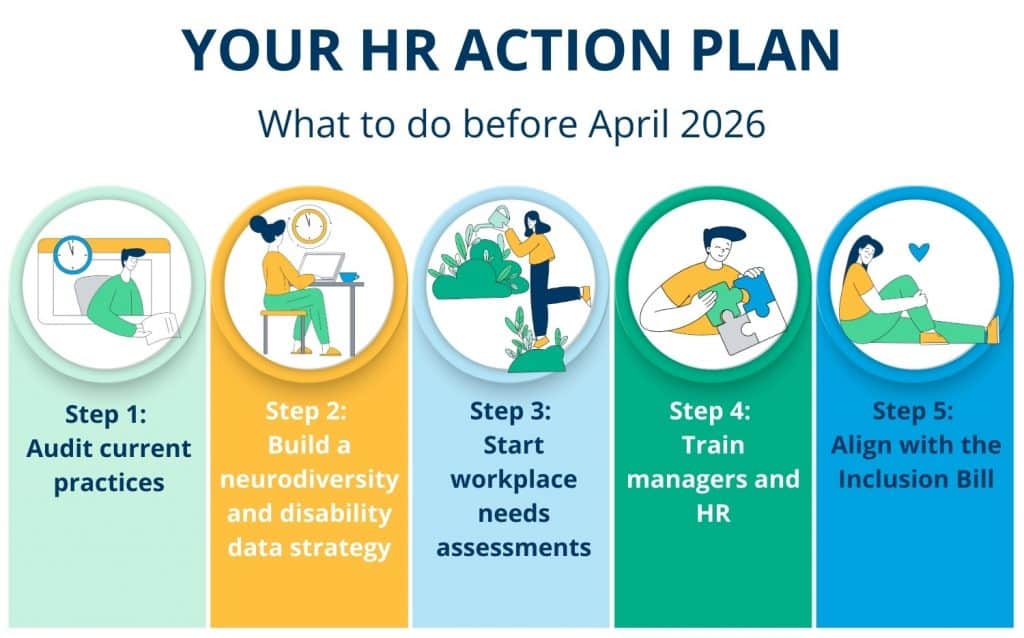

Future-proof your organisation before April 2026 with our HR action plan:
Step 1: Audit current practices
- What’s your process for workplace adjustments?
- How many staff have disclosed a disability?
- Do you have flexible working structures in place from day one?
Step 2: Build a neurodiversity and disability data strategy
- Update your HRIS to track adjustments and pay disparities
- Encourage safe disclosure via staff surveys and culture building
Step 3: Start workplace needs assessments
- Identify higher risk roles or departments
- Offer voluntary assessments for any employee who may benefit
Step 4: Train managers and HR
- Focus on spotting hidden needs
- Reinforce how to respond compassionately and legally
Step 5: Align with the Inclusion Bill
- Review supplier diversity, recruitment accessibility, and procurement inclusion
- Plan for disability pay-gap reporting from 2026 onward
A new era of accountability and opportunity
This isn’t just legal reform, it could be a cultural reset.
The Employment Rights Bill, together with the upcoming Inclusion Bill, is pushing every employer toward a more inclusive, responsive, and accountable workplace. But waiting until 2027 is a mistake. The groundwork is happening now, and those who act early will:
- Avoid legal risk
- Improve retention and morale
- Strengthen brand and recruitment
- Build a more inclusive culture that lasts
Aim Forward: Your partner in workplace inclusion
At Aim Forward, we help organisations meet legal requirements while building cultures of support and inclusion.
Our services include:
- Workplace Needs Assessments – for ADHD, autism, dyslexia, mental health conditions and more
- Training for leaders, managers and HR; how to spot signs, support adjustments, and stay compliant
- Consultancy and audits; policy reviews, process redesign, and data mapping
- Diagnostic assessments; fast, friendly access to formal diagnoses if required
At Aim Forward, we’re already helping organisations prepare.
- Email hello@aimforward.co.uk
- Call us on 0113 873 0770
Let’s move from obligation to opportunity. Let’s build a workplace where everyone thrives.

Recent Comments